
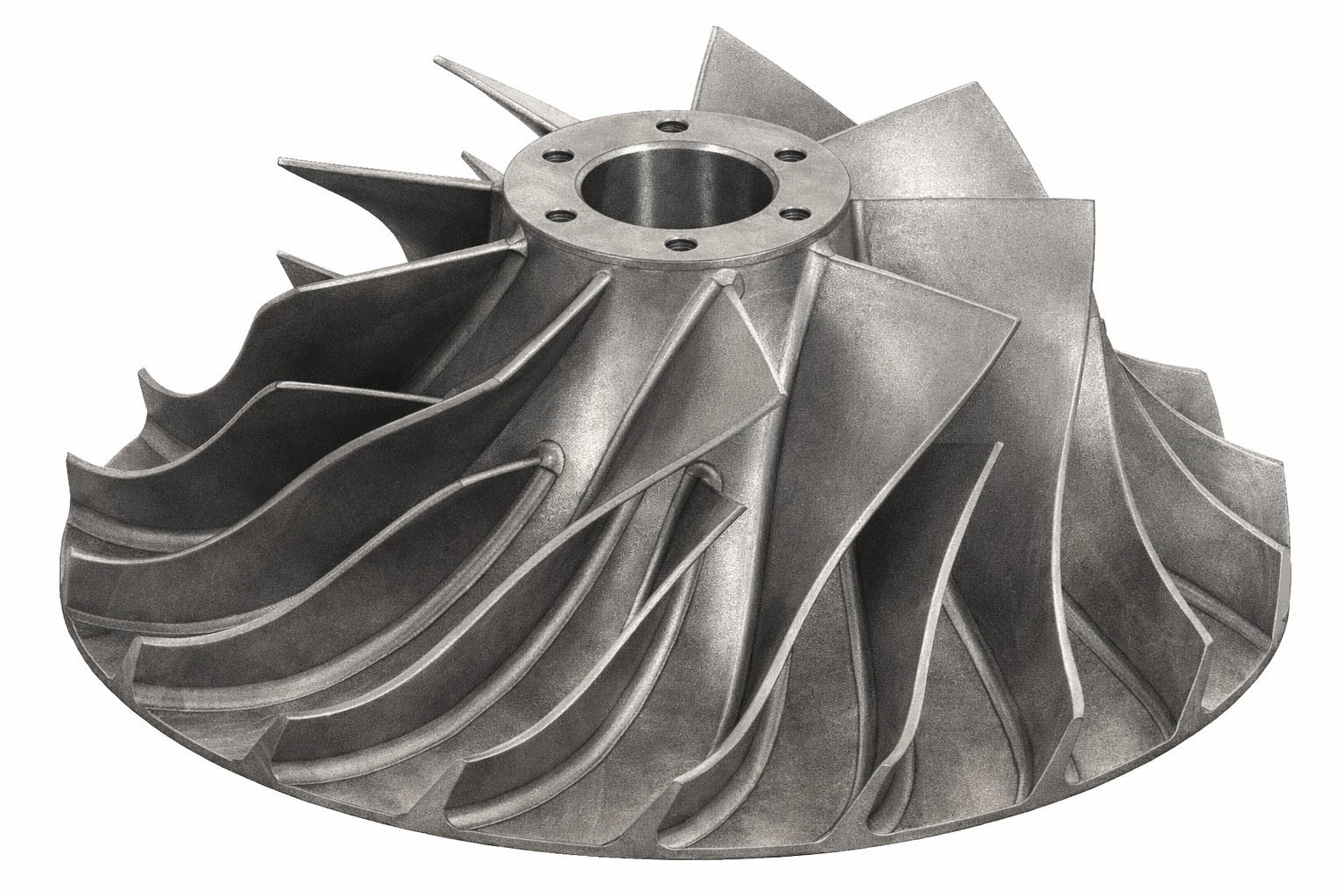
Function and Operating Principle
The rotating motion of the impeller adds energy to the flowing medium. The blades accelerate the medium radially outward, generating kinetic energy that is subsequently converted into pressure within the housing, for example in a diffuser. In the case of a turbine, the principle is reversed: the flowing medium transfers its energy to the blades, driving the impeller and the connected shaft.
Depending on design and configuration, impellers operate at very high rotational speeds, sometimes in the range of several tens of thousands of RPM. This makes them compact yet power-dense components.
Impellers achieve comparatively high pressure ratios within a small installation space, making them highly efficient components in turbomachinery.
Design and Variants
Fundamentally, two impeller designs can be distinguished: open and closed. In open impellers, the blades are freely accessible from the outside; in closed impellers, the blades are enclosed by a shroud.
While open impellers represent the standard case, closed impellers are more the exception. They are typically manufactured either from a single blank, with the blade channels milled as pockets, or first machined open and subsequently joined to the shroud, for example by welding.
Closed impellers achieve higher efficiency thanks to the shroud, since tip leakage losses are reduced, resulting in higher performance than open designs. However, designers pay for these advantages with significantly greater manufacturing effort: closed channels are harder to access, tool selection is more limited, and machining times increase noticeably. Which design ultimately gets used is therefore always a trade-off between efficiency, manufacturability, and cost, depending on how strongly efficiency is prioritized in the given application.
Fully Curved Surfaces
If the blade surfaces are curved in both the U and V directions, the blade must be machined using point milling. This process is time-intensive but allows for nearly any blade shape.
Ruled Surfaces
In impellers with ruled surfaces, the blades are designed so that the U-V lines of the surface form straight lines from the outer contour to the hub. This allows the blade to be machined using flank milling, which avoids the time-intensive point milling process.
Manufacturing Challenges
Impellers rank among the most demanding components in machining. Achieving stable machining processes requires high-end software and extensive process knowledge.
Geometry
Impeller blades consist of curved surfaces and are undercut in many areas, particularly at the transition to the hub and at the blade leading edge. Pure 3-axis or 3+2-axis machining is not sufficient here, since the tool cannot reach the undercut areas without collision, and the tool axis must continuously follow the blade contour during machining.
Simultaneous 5-axis milling is therefore required, in which all five axes move simultaneously and in a coordinated manner. Only this approach allows the tool axis to be guided so that the blade pressure side, suction side, and the often very narrow channels between the blades can be fully machined without collision with the hub or neighboring blade. This requirement places high demands on the CAM strategy, on kinematic simulation, and not least on the tooling system used.
Material
Depending on their function, impellers are made from difficult-to-machine materials such as duplex steels, titanium, or nickel-based alloys. These materials place high demands on tooling, strategy, and process design.
For aluminum impellers, machining is easier, but the demands on machine dynamics are greater, since higher cutting speeds and feed rates are used.
Difficult Accessibility Between Blades
Areas near the hub are often very narrow and, due to blade height, difficult to access. A well-thought-out tooling concept is required to machine these areas efficiently and safely.
Thin Blades
The blades of an impeller are usually very thin and tall. Machining them precisely and with good surface quality, without deformation or vibration during processing, is correspondingly demanding.
Conclusion
Impellers are central components in turbomachinery such as compressors, pumps, and turbines. Their design, open or closed, significantly determines performance and manufacturing effort. Curved surfaces, difficult-to-machine materials, narrow accessibility, and thin-walled blades make manufacturing one of the greatest challenges in 5-axis milling.
However, those who master these factors can realize highly efficient, high-performance components, provided that process, strategy, and tooling concept are properly aligned with one another. It is precisely in this interplay that the decisive difference between an unstable and a robust manufacturing process often lies in practice.
For more on our services in 5-axis machining of Impellers, visit our Impeller page.