5-Axis CAM Programming for Blisk Machining
Development of stable 5-axis milling processes for blisks and IBR components in compressor and turbine stages. Focus areas include collision-free toolpaths, consistent cutting conditions, and repeatable implementation on actual production machines.
Services for Blisk Machining
Keller Aerotech develops and optimizes 5-axis milling processes for blisks with emphasis on stable, repeatable workflows in both production and prototype manufacturing. Goals include process stability, cost-effectiveness, defined surface quality requirements, and production-ready implementation on actual production machines.
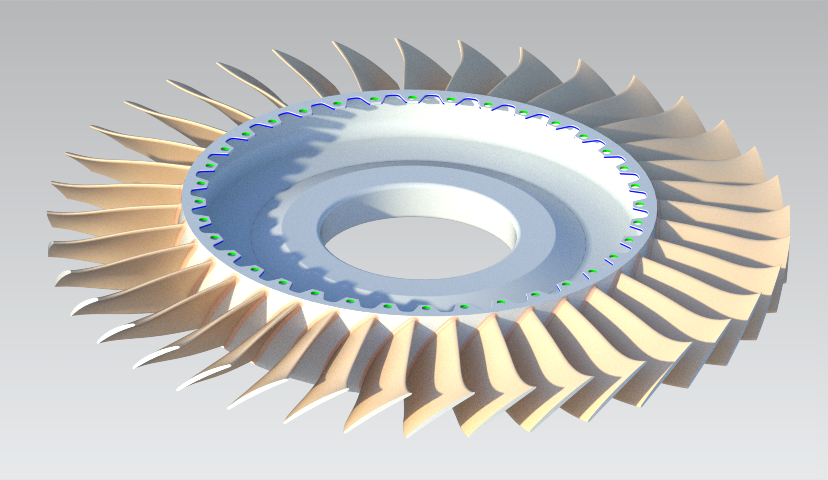
- 5-axis milling strategies for complex blade geometries
- Collision-free tool and holder concepts for large L/D ratios
- Optimized finishing strategies for blade profiles, transitions, and hub areas
- Reduction of vibration, air cuts, and unnecessary machine movements
- Technical support through stable implementation in series production
Technical Focus & CAM Expertise
Blisks place high demands on CAM strategy, tool selection, and process definition. Key focus areas include:
Geometry & Accessibility
Freeform surfaces, difficult accessibility, and large length-to-diameter ratios require toolpaths with clean approach angles and smooth axis movements.
Advanced Machining Strategies
Trochoidal roughing strategies for constant cutting conditions and strategic use of barrel cutters (circle segment cutters) for finishing operations.
Surface Quality
Uniform toolpaths, controlled contact points, and minimized transition marks at blade root, hub, and fillet radii.
Process Reliability
Repeatable operations and stable processes with controlled tool wear to prevent tool breakage, even in difficult-to-machine materials.
Cost-Effectiveness
Beyond cycle time, factors such as tool consumption, tool life, and process stability influence cost per part. Focus is set according to customer-specific project requirements.

Typical Applications
Blisk programming is typically applied where high geometric complexity, tight tolerances, and stable, repeatable production processes are required.
- Aerospace compressor and turbine blisks
- NC program development for prototypes and production-ready strategies
- Optimization and stabilization of existing machining processes
- Technical support and capacity relief for internal CAM departments
Collaboration & Contact
Collaboration is project-based, confidential, and engineering-driven. Services range from component geometry analysis to fully developed and validated NC strategies for blisk machining.