
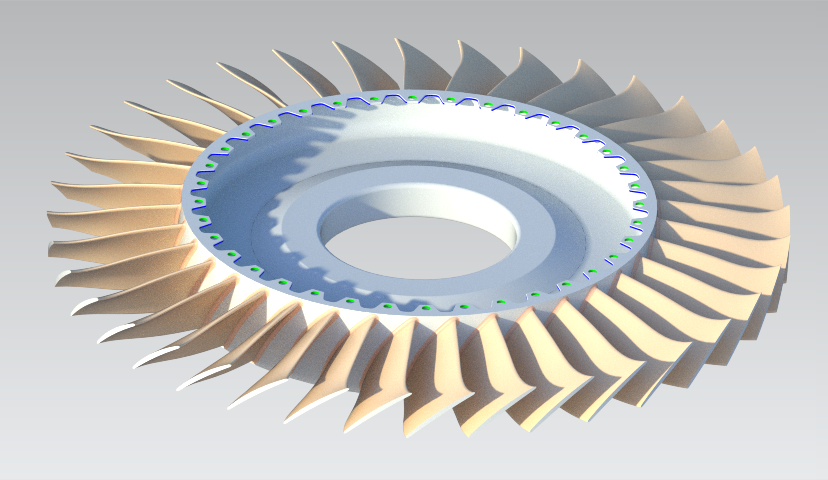
Function and Operating Principle
In a compressor blisk, rotation compresses the fluid passing through it. In a turbine blisk, the energy flow runs in the opposite direction: volume flow and pressure of the working medium are converted into rotational motion that drives a shaft.
Both designs share a common trait: they move relatively large volume flows at a comparatively low pressure ratio per stage. For this reason, blisks are frequently used in multistage compressor or turbine arrangements to achieve the required overall pressure ratio.
Design Variants
Some designs place several stages on the same rotor, commonly referred to as a blisk drum. To simplify manufacturing, individual stages can also be machined separately and joined afterward by friction welding.
For very large blisks with correspondingly tall blades, integral machining from solid material quickly reaches its limits. Such components are sometimes designed so that the blades are manufactured individually and then friction welded onto the hub.
Another special variant is the closed blisk, where the blades do not end freely but are firmly connected to a shroud or the outer contour. This design adds further demands on the machining strategy due to restricted tool access.
Manufacturing Challenges
Blisk manufacturing is considered one of the most demanding tasks in 5-axis machining, for several reasons.
Thin walled turned contours
Labyrinth seals, precise flanges, and other rotationally symmetric features require extremely tight tolerances combined with thin wall sections. Residual stresses in the raw material as well as stresses induced by the workholding must be accounted for during process design, since they can affect part geometry after machining.
Complex blade geometry
Blades must achieve a high surface finish and precise geometric accuracy. Due to their curvature, this typically requires a 5-axis toolpath that continuously adapts to the blade shape.
Long, slender tools
The complex, often deeply recessed geometry frequently calls for long, thin tools to avoid collisions with adjacent blades or the hub. Because of their slenderness, these tools are much more prone to vibration, which directly affects surface quality and tool life.
Difficult to machine materials
Blisks are predominantly made from titanium and nickel based alloys. Both material groups are known to be difficult to machine and require careful attention to tool selection, cutting parameters, and process design to avoid excessive tool wear and thermal damage to the part.
Requirements for process stability
In aerospace applications, high demands are placed on process stability and on how machining affects the base material, commonly referred to as surface integrity. These requirements need to be considered early in process development, not only during final quality inspection.
Conclusion
The integral design makes blisks lighter and more efficient than conventional rotor constructions, but this comes at the cost of a significantly more demanding manufacturing process. Tool selection, workholding concept, and process design are the key factors that determine part quality and cost effectiveness. Upcoming articles will look more closely at individual aspects of these challenges, including tool selection and workholding strategies for thin walled rotor components.
For more on our services in 5-axis machining of blisks, visit our Blisk page.